
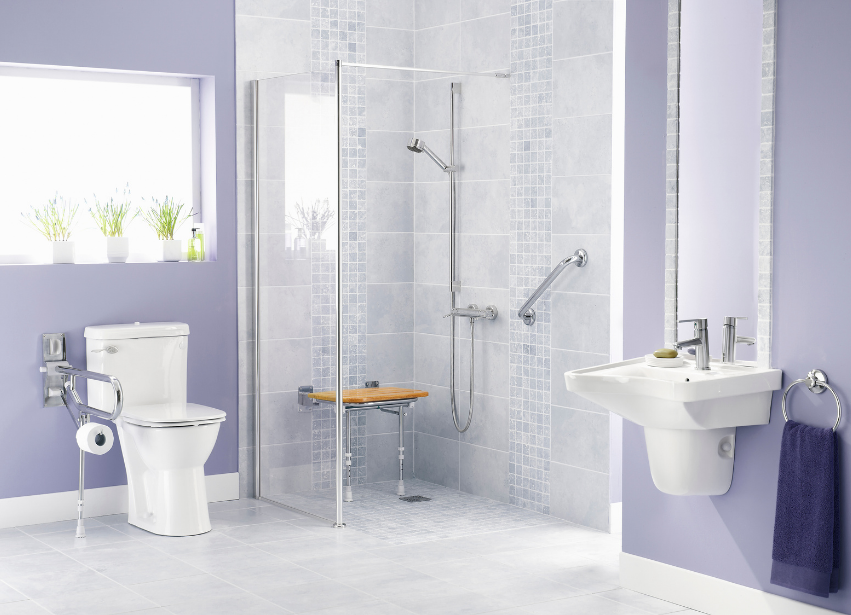
Accessibility is one of the most worthwhile reasons to fit a new bathroom. Done well, it is invisible. The room still looks like a beautiful modern bathroom, but it works for an older self, a wheelchair user or anyone with limited mobility. This guide covers what is genuinely possible in a Glasgow home and how funding works in Scotland.
For the work we carry out, see our accessible bathrooms page. This article sits alongside our complete guide to bathroom fitting in Glasgow.
What an accessible bathroom can include
Accessible bathroom design is not a single product. It is a set of design choices that add up.
- Level access shower. A flush or low-profile tray, or a fully tanked wet floor, so there is no step to negotiate.
- Reinforced walls. Plywood pattressing behind tile so grab rails can be added or moved later without ripping things apart.
- Fold-down shower seat. Wall-mounted and rated for the weight that matters.
- Thermostatic shower valve. Prevents scalding and is easier to use with limited grip.
- Wider doorways and clear turning space. Eight hundred millimetres minimum for the door, with a clear circle inside the room wherever possible.
- Comfort-height WC. Slightly higher pan, easier to use, with reinforced fixings for any future support rail.
- Lever taps and contrasting fittings. Lever handles are easier for arthritic hands, and visual contrast helps people with reduced sight find the controls.
The Scheme of Assistance
In Scotland, most accessible bathroom funding comes through the Scheme of Assistance, run by your local council. Glasgow City Council, East Renfrewshire, East Dunbartonshire, South Lanarkshire and the other surrounding councils each operate their own version under the same statutory framework.
The Scheme of Assistance can provide grants for adaptations to your home where they are assessed as essential. For owner-occupiers it usually covers a significant share of the cost of essential adaptations, with the exact split depending on means assessment and the type of work. Council and housing association tenants generally have adaptations arranged directly by the landlord rather than as a grant.
Rules and percentages do change, so always check the latest position with your local council or with an independent advice service such as Care Information Scotland before committing.
How the process usually works
- Referral. An occupational therapist, often through your GP or social work team, assesses the need and recommends specific adaptations.
- Application. The local council processes a Scheme of Assistance application, often alongside the OT report.
- Approval and quotes. Once approved in principle, you get quotes from suitable contractors. The work has to match what was approved.
- Installation. The work is carried out, usually inspected afterwards.
- Payment. The grant is paid against the agreed scope, often directly to the contractor.
Lead times vary by council and by demand. It is normal for the assessment and approval stages to take longer than the actual installation.
What if you are paying privately?
Many households want an accessible bathroom for future-proofing rather than for a current diagnosed need. That is a perfectly good reason to fit one, and it sits outside the Scheme of Assistance. The good news is that future-proof features such as reinforced walls and level-access showers add very little cost when designed in from the start.
For older homeowners thinking ahead, a sensibly planned accessible bathroom usually adds value rather than diluting it. It looks like a high-end bathroom today and works as an adapted bathroom tomorrow.
Common Glasgow examples
In a Bishopbriggs bungalow, the most common accessible move is replacing a low bath with a level-access shower and adding a wide reach mixer at the basin. In a East Kilbride family home, an en suite is often converted to an accessible wet floor while keeping the main bathroom traditional. In tenement flats, the move is usually a low-profile tray and a comfort-height WC because true zero-threshold floors are harder.
What this kind of work asks of a fitter
Accessible bathroom work needs a fitter who can hold the design intent together as well as turn taps. Reinforcement has to be in the right place, falls have to be correct, fittings have to be installed at standard accessible heights, and the room has to feel calm, not clinical.
We plan and fit this detail ourselves, at design stage rather than as an afterthought. Our guide on how to find a trustworthy bathroom fitter in Glasgow applies even more sharply on adaptations than on standard refits.
Where to start
If you are exploring grant funding, start with your local council or your GP. If you are planning privately, send us your details on the quote form and we will arrange a free design visit to work through the options in the room itself.