
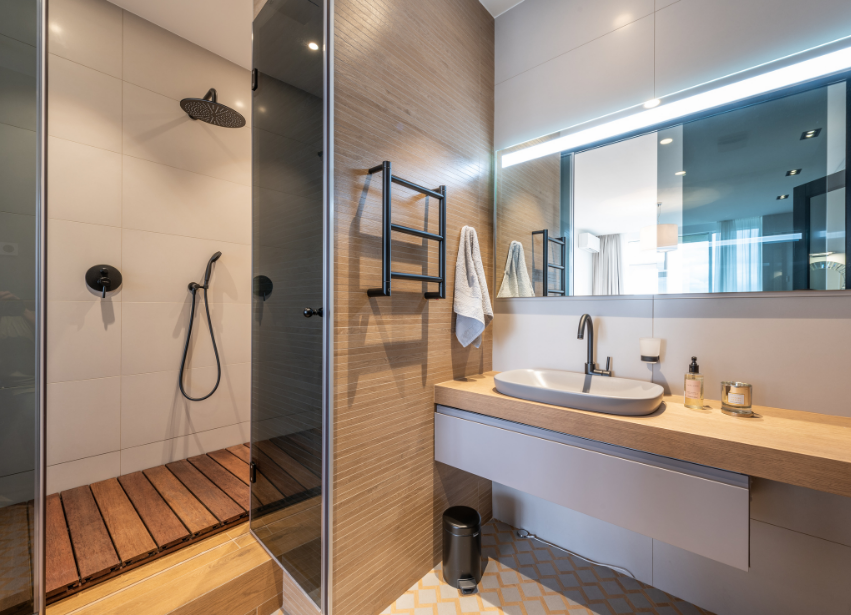
People use the words interchangeably, but a wet room and a walk-in shower are not the same thing. The difference matters because it changes the budget, the programme, the floor build-up and the way you live in the room.
This guide is part of our broader complete guide to bathroom fitting in Glasgow.
What is a wet room?
A wet room is a fully waterproofed bathroom. There is no shower tray and usually no enclosure. The whole floor is built up with falls to a drain, the walls and floor in the shower zone are tanked with a waterproof membrane, and the whole thing is then tiled over. Water can land anywhere and the room simply drains.
We cover the engineering side of it in our service page on wet rooms Glasgow.
What is a walk-in shower?
A walk-in shower keeps most of the room dry and only the shower area gets wet. It usually has a low profile or flush tray, a fixed glass screen on one or two sides, and an open entry. The shower area is still waterproofed properly, but the floor outside it is not designed to be soaked daily.
More on the options is on our walk-in showers page.
The honest pros and cons
Wet room, pros
- Easier to clean. No tray edges, no door seal, no shower screen runners.
- Genuinely accessible. Zero threshold makes it easy to walk or wheel in.
- Visually calmer. Fewer components, more continuous tile, a more spa feel.
- Future proof. A wet room you fit today still works in twenty years.
Wet room, cons
- Higher cost. Tanking, floor build-up and falls are real work.
- Slower programme. Drying times for membranes have to be respected.
- Unforgiving of poor workmanship. A wet room tanked badly is an active leak waiting to happen, so the detailing has to be right. See bathroom waterproofing and tanking.
- Can feel cold if extract is poor or underfloor heating is skipped.
Walk-in shower, pros
- Lower cost, faster programme, more forgiving of imperfect floors.
- Works in almost any Glasgow bathroom, including most tenement flats.
- Keeps the rest of the room dry, which suits family bathrooms.
Walk-in shower, cons
- Tray edge and screen create small cleaning jobs that never go away.
- Not as genuinely accessible as a flush wet floor.
- Cheap trays can creak, cheap screens can drag. Spend properly here.
Which one suits your home?
Pick a wet room if
- You are planning long term and want a bathroom that will still work for an older you.
- You have a ground-floor concrete slab, which makes the floor build-up easier.
- You have a second bathroom or family bathroom and this room is becoming the shower room.
- You prefer a quiet, minimal aesthetic and are willing to invest in doing the tanking properly.
Pick a walk-in shower if
- You have one main bathroom for the whole household and want to keep a bath option in some form.
- You are in a Glasgow tenement upper flat where floor build-up is restricted.
- You want a strong upgrade on the old tray-and-door enclosure without a structural rethink.
- You are on a tighter budget but still want to lose the bath.
Common Glasgow scenarios
In a typical Shawlands or Pollokshields tenement flat, a walk-in shower with a low tray is often the safer choice because of timber floors and shared structure. In a Bearsden or Newton Mearns family home with multiple bathrooms, a full wet room en suite is a great way to add a genuinely different feel to one of them.
The middle ground
You do not have to commit fully to either. A wet zone with a single fixed glass panel is one of the most popular compromises we see in Glasgow. The shower area is fully tanked and level access, but a single panel keeps the rest of the room mostly dry. It looks like a wet room, behaves a bit like a walk-in shower, and is forgiving on a family bathroom.
Next step
When you are ready, book a free design visit and we will look at the floor, the drainage and the space you actually have before recommending one or the other. We design, supply and fit both, so the advice is about your room rather than about what is easiest to install.